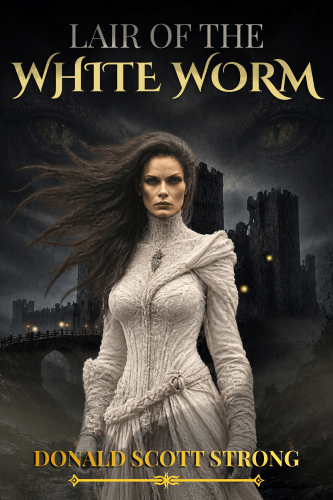
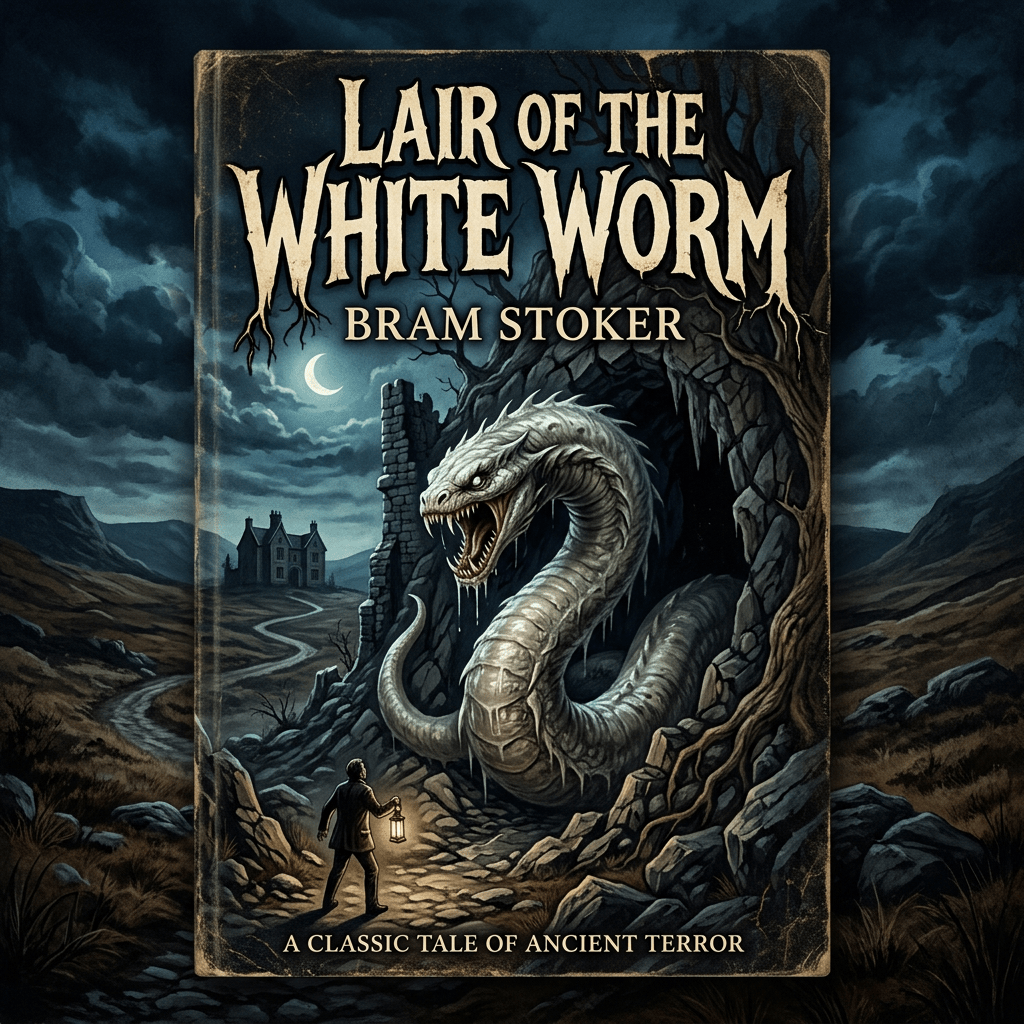
It took only five years and six artists, but I finally found someone willing to actually, y’know, do the cover.
My concept was much more dramatic—that definition of “dramatic” that means “cluttered”—but I’ve discovered that, the way people discover books these days, you have to kind of make your cover look like everyone else’s, but also different.
I couldn’t have the snake winding up the tower because that would create another focus and also suggest “creature feature,” which isn’t a gothic horror. I couldn’t have Arabella’s eyes glowing because that would suggest “evil sorceress,” which is part of the … IDK … “dark fantasy” genre.
Arabella’s a bit more…developed…than I envision her, and while I didn’t envision her white gown quite looking like this, I kind of like the way the pattern suggests (gently) scales or something organic.
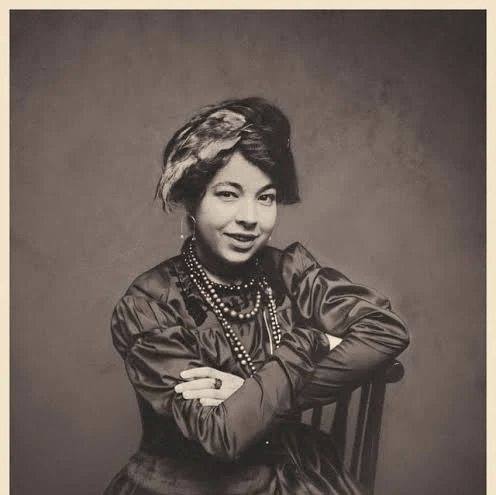
Let’s check back with Pamela Colman Smith!
Still looks like Bjork to me, sorta.PCS’s Lady Arabella
NGL, that sounds like a kick-ass idea: Stoker v Lovecraft! But this concerns my earliest introduction to Stoker’s novel:
Better known…is the ingenious Bram Stoker, who created many starkly horrific conceptions in a series of novels whose poor technique sadly impairs their net effect. The Lair of the White Worm, dealing with a gigantic primitive entity that lurks in a vault beneath an ancient castle, utterly ruins a magnificent idea by a development almost infantile.
This is fair. But while looking it up I discovered that HPL harbored a conspiracy theory that Stoker hadn’t written any of his novels. That he had presented his editors with a mess and they had done the actual writing for him.
First, I want to clarify, I don’t know the extent to which he harbored this idea. It was apparently based on correspondence he’d had with an editor who refused to work with Stoker on Dracula, who described the mess. It’s possible that he got the idea stuck in his head and carried it to his grave, or that it excited him for a while and then he later set it aside as he did some other ideas.
I can see HPL, a fussy New England shut-in, not being able to grasp the way Stoker—a theater manager!—worked.
Also, it’s easy to be a perfectionist when the longest thing you write is in the 40,000 word range. Dracula is about 4x that and one of the vanities a sharp intellect seduces you into is thinking “Well, if I couldn’t do it, this moron couldn’t either!”
Well, yeah, maybe nobody could work the way HPL did (including HPL) for a novel. I suspect Stoker was comfortable of levels of chaos that would’ve put HPL into an even more premature grave.
Having read all of Stoker’s work at this point, I can aver that it is all very consistent. The world-view, the writing style—which isn’t to stay that Bram didn’t grow over the years—even the things I would consider defects, they’re all very consistent book after book.
I would say, for example, that he had trouble with endings. Dracula‘s, for example, is woefully inadequate to the previous 155,000 words. That’s his fifth book! His ninth book, The Man, finally nails it. He overplays the ending slightly in his tenth book, The Lady Athlyne and then he has a stroke, so the last third of The Lady of the Shroud is geopolitical musings and science-fiction.
And then there’s Lair of the White Worm where he goes full Evil Dead for the ending and then the last lines are:
Come home as soon as you can. I shall see that breakfast is ready. I think we all want it.
HPL saw LotWW as a senile Bram Stoker revealing himself as a fraud. My counter-argument is that it’s the very fact that the novel is a mess that proves Stoker wrote all his own work, and the editorial influence may have ebbed and flowed but it didn’t constitute all that much of a contribution.
If all his efforts had been the work of an unknown editor, Lair of the White Worm would’ve been cleaned up before release, just like his other books.
Furthermore, there’s no reason to assume (that I can see) that anyone would’ve offered such services to Stoker. He wasn’t some kind of name—a proto-Roald Dahl, let’s say, calling on an example of a guy who, in his later years, used to turn in messes. Even Dracula sold something like 2,500 copies on its first run. He had to condense it to cheap paperback form to collect royalties at all.
You’d have to be H. P. Lovecraft—or a modern indie book writer—to consider that level of sales to be success.
Now that I have Mimi’s situation worked out, nicely I think, there is the whole Edgar/Lilla relationship issue. Stoker, after a possible…typo?…where he has Adam falling in love with Lilla (before course correcting to have him end up with Mimi), clearly means for Lilla to set her cap on Edgar.
The problem is, they have three or four interactions: The party, the first staring contest, the second staring contest (which might be the first, repeated, but I don’t think so), and then he kills her.
I’ve got a lot of support for Lilla wanting to help Edgar. That is, I’ve developed her character to the point where at least it seems possible for her to be in a situation to find him attractive, but for actual actions, there’s still the whole “every time we get together, he tries to mesmerize me” thing. (Who does he think he is? Scott Adams?)
I have the mechanism for his potential reform, which must exist lest the reader think Lilla is an idiot. (She might be, and the reader might be inclined to feel that way, but they must at least understand how she came to do idiotic things, or she may become unsympathetic.)
The thing is, Edgar has his own issues, so if his potential reform is too reformative, then we will feel cheated if he just does a heel-turn, and we also won’t believe he’s very menacing if he’s out…IDK…feeding orphans.
See, this is why I type this stuff up: By saying it out loud, or at least writing it out, solutions reveal themselves. It might be worth a re-read of Red Dragon, actually, since the serial killer in that proves to be rather sympathetic at times. Not that Edgar’s a serial killer, exactly. But he’s probably messed up psychologically on that level.
Meanwhile, Arabella.
When you think about it, the source has four villains, which is a lot for a short book. Edgar, Oolanga, Lady Arabella and the White Worm itself. Regardless of Stoker’s apparent plan to make the last two one and the same, they actually behave as completely separate characters (and are seen together only once, in corpse form).
And a weakness of the book is that the White Worm does literally nothing till about 2/3rds of the way through, and if we’re being honest the only thing Arabella does is kill Oolanga in a very confusing scene that could be read as self-defense.
Arabella has to be more active. The other characters (including Uncle Richard and the White Worm) have all stepped up, and it’s time for the Lady to start causing even more mischief.
There is one element of Stoker’s style I shall not directly imitate, to wit: His practice of editorializing in the author’s voice. For example:
“If only women knew how greatly appreciated these small gestures of thoughtful kindness meant to a man, and how value it added to her and their marriage when noticed, while for their part, if only men strove to notice the little details wives put into everything…”
Fake Quote
Stoker does this across every book of his I’ve read so far. I made the above up because I don’t have a text handy to copy from, but here’s a very mild case from LotWW:
So soon as Adam’s eyes met those of the younger girl, who stood nearest to him, some sort of electricity flashed—that divine spark which begins by recognition, and ends in obedience. Men call it “Love.”
Bram Stoker, Lair of the White Worm
By the way, he’s talking about freaking Lilla, which immediately flips to Mimi within pages.
Anyway, as much as I love the Victorian authorial voice when I read it, it feels too whimsical to put into a horror novel as such. But I’ll call it a semi-sacrifice because the characters can editorialize in this fashion, so expect some of that.
I beg your pardon and your indulgence in a question of a peculiar literary nature. In Bram Stoker’s “Lair of the White Worm” there is a vignette that does not ring true to me. It begins:
“As she spoke she pointed to where one of the heavy springs was broken across, the broken metal showing bright.”
And ends:
“So soon as this was done, Adam took some tools from his uncle’s carriage, and at once began work on the broken spring. He was an expert workman, and the breach was soon made good.”
I would think a truly broken spring, enough to show the “broken metal showing bright” would have to be removed and replaced or, minimally, re-forged. For context, the story was published in 1911.
I would appreciate any insight you might have into this topic.
Trying not to look too much like a maniac, I found myself studying old English road maps and trying to pick up clues as to where The Lair of the White Worm is at. Searching for more information, I turned up this site for walking tours. It brought up a map as though there were an actual circuit you could make to tour the titular lair. It may have been something that just walked you past the sites the movie was filmed at, and probably was, except I did notice that the site does not, in its own search, turn up anything for “lair”.
There is this talk about breezes coming in from the eastern sea (Chatper XL, “Wreckage”) and the book does a mighty hard job of convincing you it’s right along the eastern coast of England. Moreso and moreso as the book moves on. While this is unsupportable, I had initially imagined the lair as being situated just to the east of the eastern border of Derbyshire, with the worm-side of the Brow—as represented by the cliff face that’s blown out—facing seaward.
But the actual description of the arc of the brow, from early on the book makes it clear that Castra Regis is at the westernmost point of the north—probably north—end and swoops eastward and southward, and the lair is on the inside. The flat plains stretch out to the east, per the book. Also, we know that Doom Tower is just over the border of Derbyshire.
Derbyshire has a long border, as befitting a highly irregular rectangle.
Doom Tower was a lofty structure, seated on an eminence high up in the Peak. The top of the tower commanded a wide prospect ranging from the hills above the Ribble to the near side of the Brow, which marked the northern bound of ancient Mercia.
OK, so, I take that back, Castra Regis must be at the SOUTH end of the the Brow and Doom Tower must be at the north. Mercia was, at the height of the empire quite large, but if we assume the Peak is quite high, we can weasel our way out of that one, though it’s less and less supportable the further south we go on the Derbyshire border.
Unfortunately, as we go north and west, we have another trouble: Wolverhampton. That is our closest major city, we know this from both Arabella:
“Soon? I shall have to wait till we get to Wolverhampton. There is no one near who can mend a break like that.”
And from Mimi:
“I had my electric torch that you gave me recharged the day I was in Wolverhampton with Sir Nathaniel.”
Mimi was never in Wolverhampton with Sir Nathanial, as far as I know—when? how? why?—but let’s not lose the plot. The point is, Wolverhampton is the nearest big city. What’s more, Chapter I gives us the journey that Uncle Richard is taking and his first major stop is Stafford—a city just 15 miles north of Wolverhampton. This suggests a location on the southern border of Derbyshire.
Yet, when they’re racing against TWW, what’s their first stop? Macclesfield, which is to the north, but then doubling back south to Congleton. For all intents and purposes, it seems like the lair would have to be in Derbyshire, in order for this to make any sense. But why do we think it’s outside Derbyshire?
My old friend, Sir Nathaniel de Salis, who, like myself, is a freeholder near Castra Regis, though not on it—his estate, Doom Tower, is over the border of Derbyshire, on the Peak…
Y’know, it could be “over the border” as in “we’re inside and he’s outside”. Like “He lives over the Mexican border, in Texas” said somebody in Juarez. There is this, of course:
I live, and have for many years lived, in Derbyshire, a county more celebrated for its caves than any other county in England.
But if you lived just over the border in an ancient land, and the whole area—which includes the Peak District—would you think of it all as Derbyshire? Where are my ancient county maps? Hmmm. Derbyshire didn’t used to be quite so rectangular, according to this game map:
Confirmed by this map from the 19th century:
You can even see the High Peak on that one!
You can’t see it on either map—or at least I can’t, not sure if I cut it off or what—but the further north you go, the closer you are to Manchester. No way do you go to Wolverhampton if you’re that close to Manchester. So it’s got to be pretty far south—enough to make that trip more appealing. Maybe it’s also an easier journey if you’re deep in the mountains.
Derbyshire was pretty remote and underdeveloped until the 19th century, which is probably why Stoker picked it.
The penultimate stop on their chase, just before Liverpool is Runcorn:
That’s a 19th century street map!
So, our heroes have to get from Macclesfield to Congleton to Runcorn:
Something like this:
The actual route is much more circuitous, obviously, what with being done by road and all that. But I have the characters taking certain shortcuts and I can actually back that up!
So where are they, relative to Macclesfield? I’m thinking something like:
These are the highest areas of the Peak District. Now, it’s still closer to Manchester than to Wolverhampton, but depending on the Lair’s position, it could make a lot more sense to go south rather than north, through hilly terrain.
Re-reading Dracula and, yeah, I think we can say that Bram liked to organize his action around meals. I don’t think I can get away with that. “Dinner is ready,” isn’t really a good cliffhanger chapter end these days.
Here’s an interesting thing, at least to me: Mimi is the target of the Worm’s ire in the source, and that’s a major plot-point. The whole tea-with-Wormy and subsequent chase—which is absolutely a monster set piece in the rewrite—depends on The White Worm wanting to go after Mimi.
I’ve visited and re-visited Mimi trying to figure out why. I think Stoker was going for a snake-charmer thing: The idea was probably that Mimi was going to, somehow, be able to stare-down the WW perhaps with the aid of the Aeolian harp (which, I confess, I have retained), but if she had this power I can see no way for her to discover it without either neutering the snake (ouch!), evolving the power somehow, or going full Buffy.
The latter is right out. (I had an English teacher say you could only use “latter” for the last two items, but Stoker uses it pretty routinely to mean the last of a list, and the dictionary bears out Stoker on this one.) The Buffy tropes were pretty tired when Whedon trotted them out, but they are stupid-worn-out now.
Evolving the snake-charmer power also presents a problem: We have to assume this is a racial feature—which I don’t have a problem with per se, as the book is all about “race”, in the sense of the features of one’s particular lineage or tribe—that Mimi develops, but if she really develops it, in means she has to confront our Nemesis and be able to stare it down.
I dunno. Stoker loooooved him some staring contests. But I’ve already got more than I can handle with just Caswall. And while the text is thick with various forms of mind-control—I mean, I’ve thickened it, because Edgar was just awful at it in the source, so he has to be able to do something with it—it’s also a fairly sinister power, which does not suit our Dear Mimi whatsoever.
And it neuters the snake, as it were, because if it can just be stared down, it ain’t all that scary. The beast has to have an imposing physical presence, I think.
So I’ve figured out why the White Worm wants to kill Mimi in a way that doesn’t involve her being super-powered and ties into the denouement already written. (Writing backwards was such a boon in doing this.)
Anyway, none of that is the interesting thing I was talking about earlier. The interesting thing is that I’ve revisited the characters and strengthened them in my own mind, and in ways that I think reveal them better to the reader, and as I’ve done this, Adam has become a worse and worse character.
I started this transition from the get-go, having him be more puckish, and rather antagonistic to Edgar.
But he’s also the stand-in for the Dear Reader, alas. He has to carry the disbelief. And this has made him increasingly obnoxious, as I anticipate a “normal” response to the ideas being presented. (Mimi can also be a little bitchy, but her reasons are a lot better.) This makes the Snake Reveal better because he’s has to come around awful fast, but I will have to go back (again) and refine things so that he is more the pragmatic and upbeat hero, and less a whiny little brat.
Most of the characters (except Uncle Richard?) have analogues in Dracula. Lucy and Lilla, Mimi and MIna, Sir Nathaniel and Van Helsing, Edgar and Dracula, and Adam… He’s kind of like John Seward or maybe more like Quincey Morris, the Texan. He doesn’t know what the hell’s going on, he just takes Van Helsing’s word for everything and goes.
I’m adding little bits (Easter eggs?) from Dracula to this in homage to the better Stoker. I hope he would appreciate it.
I’ve set down most of the events of the story by this point, with just a few crucial plot points missing. There are quite a few non-crucial ones and elements that need to be reconciled for the sake of continuity, but I believe I’ve made the last major change that was needed for things to hang together.
Specifically, Edgar tries his Mesmer tricks thrice (in the source), being thwarted twice by Mimi on the first two instances, and murdering Lilla (while Mimi runs around England) on his third attempt. I feel like he may have even had a “try 0” at the introductory party, but the main issue is that after two (or three) attempts Lilla invites Caswall over when Mimi is out of town while dreaming of a potential marriage!
And then, when he accepts the invitation, she behaves for all the world as though it were something she were forced into “for her father”. Who, by the way, is not around. (And is her grandfather.) This is something I’ve been struggling a lot with: An unmarried, unescorted minor female does not invite a man to her home, right?
But I can make no sense of the manners in this book. And while I’ve been researching it heavily, I’m more interested in Lilla having a reason for continuing to confront Edgar. I think I’ve managed that, but there was one bit of shifting that was necessary: There had to be some time between the first and second battles (which are definitely distinct in my telling) and there has to be: continuing pressure on Lilla to see something salvageable in Edgar; continuing pressure on Edgar to drive him away from any chance of being salvaged, no matter how badly he wants it.
Anyway, the doves & kite plotline has been moved up, or at least the second battle has been moved back, and that gives me the timeline to make the story more convincing, at least to my modern mind.
Anyway, I did all this to get the story down, and without regard for emulating Stoker’s writing style, though I have found in certain details that I have written elements more like Stoker than Stoker himself allegedly did in LotWW. (Yes, I think we can believe safely that the book was not entirely written by Bram in his final year. The degree to which his wife or publisher filled in increases in my mind the more I read and re-read.)
I’m currently re-reading Dracula, because I don’t think LotWW is representative of Stoker much at all, much less his best work, and am picking up on some very distinctive stylistic elements. Certain sentence structures, and particular details noted, things like that.
One thing that caught my eye right off was a reference to the calèche Jonathan Harker takes on his journey. A calèche is a style of horse-drawn carriage (four in an open cabin with a driver at the front), of which there were many, many styles, naturally, many of which—if one reads pre-20th century literature at all—one becomes familiar with. So it surprised me that Lair simply uses “carriage”—especially, as previously noted, when a carriage chase is so important to the third act.
So, yes, I have been quite particular about this in my writing.
Now for the more problematic parts: Grammar, food and travelogue.
It must be confessed that, even in my prolix style, adding vast swaths of missing backstory, characters, and plot points, I would probably not touch the 75-80K words of the original text. The sentences in Dracula are, shall we say, rich in structure. I may have to diagram these.
That said, I also, almost certainly, will have to dumb them down. This as less of a concession to the readers than to the writer (me) as I make it a rule not to (deliberately) write any sentence I can’t understand. I will try to capture the flavor of the style without slavishly adhering to it.
Food: I am struck by how, early on in Dracula at least, Jonathan Harker is pre-occupied with his meals. I attributed the constant focus on food in LotWW with Stoker’s advancing age, and that may still be the case, recalling that one was certainly on the wane by his 40s back in Victorian England. On the other hand, Stoker was Irish and lived in London, so it may be that the concept of having food with flavor was sufficiently startling to require mention in Dracula.
Which brings us to the travelogue stuff. As interested as readers used to be in descriptions of landscape and foreign lands, modern readers are generally not.* In LotWW, the geography is critical, and the plan all along has been to lay it out clearly, perhaps even drawing a map. (Gasp!) The chase scene basically mandates it, and I’ve screwed some of that up by mismatching the descriptions of the countryside with what is (or would have been) actually there, but that’s all fixable.
A fourth point, I think I’ve commented on previously, is that Stoker seemed to find real estate transactions a fruitful literary device. I’ve subverted that somewhat: There is a real estate deal in the offing but nobody suspects the true motives.
My goal is to have the not-too-rough draft finished this month!
Yrs,
===Blake===
*Mrs. Radcliffe filled her pages with rich, heavily detailed text descriptions of places she had never been. That’s why she was the J. K. Rowling of the 18th century.
He appears in a Mimi flashback during tea with the snake. Also, tea has been moved back to luncheon, or there’s no way they can get to Liverpool on time.
Sunset’s around 9PM these days in Liverpool, so that helps.
Stoker had a stroke in 1906, and so I’m thinking that Stoker’s mental state wasn’t due necessarily syphilis but mini-strokes. In fairness (to myself) I also didn’t think it was any big deal if it were syphilis. I don’t see it as a great failing to have been born before the invention of penicillin.
Yes, yes, it means he had sex! I can hear the Boomers yelling “A ha! Hypocrite!” already, though I’m not sure anyone had suggested otherwise. Our modern view of sex would put any previous known era to shame, I think, including late Greece and Rome.
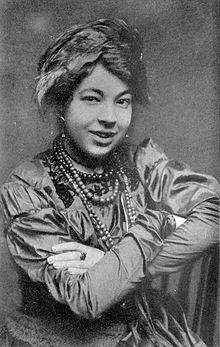
Anyway, this is kind of fun. The awful, awful illustrations of LotWW were done by Pamela Colman Smith who recalls, to me, Bjork:
Were you brought by the stork?
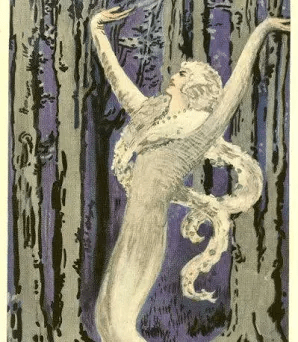
Her contributions to the book include:
I understand there were challenges, but…
But Ms. Smith was also the artist on the Waite-Smith tarot deck, which is positively iconic. I mean, you’ve seen these, right?
Tenacious D based an album cover on this one:
Wikipedia says over 100 million decks have been printed. That’s, like, a million a year forever.